Reading a pay table
Understand credits, the '9/6' shorthand, and short-pay games.
Read awards in credits, not profit
A pay table lists how many credits are returned for each final hand. The return includes the wager. If you bet five credits and a pair of jacks pays five, your balance returns to where it started: five credits came back, but the hand made no profit. A 10-credit award on that same wager produces a five-credit profit.
The 9/6 shorthand
Players often identify a game by the pay-table lines that distinguish common versions. In Jacks or Better, those lines are the full house and the flush, quoted at their per-credit rates. “9/6 Jacks or Better” pays 9 credits per credit wagered for a full house and 6 per credit for a flush.
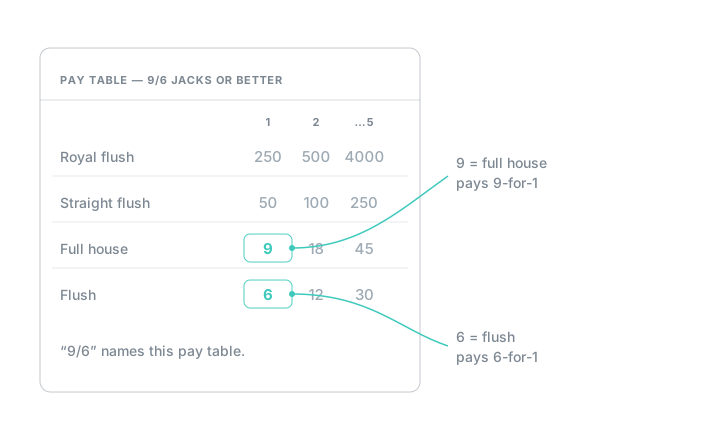
The shorthand is family-specific. A 9/7/5 Double Bonus label refers to three lines, and names such as NSUD identify an entire Deuces Wild schedule. Shorthand helps compare familiar tables; it never replaces checking every row.
Why this trainer uses five credits
On the traditional schedules modeled here, a royal flush returns 250 credits per credit wagered at one through four credits. At five credits, the total award jumps from 1,250 to 4,000 credits—800 per credit. That bonus materially increases the game’s return and can change strategy, so Sharper Edge models the five-credit game only.
Not every real machine uses this exact schedule. Some have different maximum wagers, progressives, or feature bets. Compare the complete table before playing; a name that looks familiar is not enough. Those machine-specific variations are outside this trainer’s model.
Spotting a short-pay table
A short-pay table lowers one or more awards while keeping the game’s familiar name. The change can look tiny and still matter on every future decision. Sharper Edge includes two Jacks or Better versions that isolate the effect of one changed row:
| Game | Full house | Flush | Return | House edge |
|---|---|---|---|---|
| 9/6 Jacks or Better | 9-for-1 | 6-for-1 | 99.54% | 0.46% |
| 9/5 Jacks or Better | 9-for-1 | 5-for-1 | 98.45% | 1.55% |
Lowering the flush from 6 to 5 cuts the configured return by 1.09 percentage points, from 99.54% to 98.45%. The house edge rises from 0.46% to 1.55%—more than three times as large. Even the same four-card flush draw falls from 1.213 to 1.021 expected credits per credit wagered.
Try it at the table
Practice 9/6 Jacks or Better, then compare its game page with 9/5. Flush draws make the changed award easy to see.